
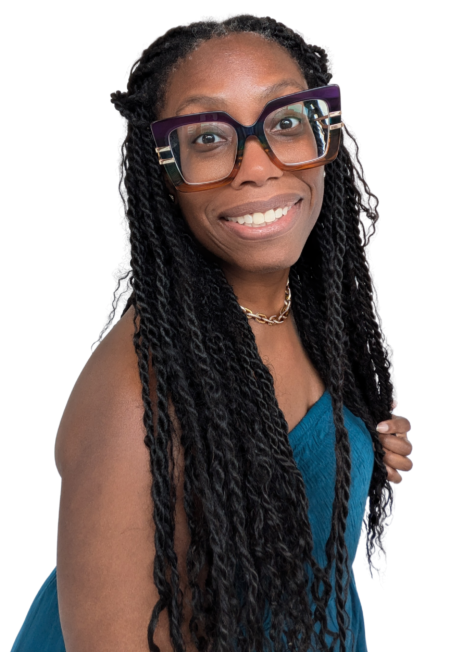
Hello, I'm Dr.E.Veal!
I’ve probably changed careers more times than J. Cole drops mixtapes!
I started out as a high school Geometry teacher. There, I inspired low to middle-class high school students to pursue higher education in STEM. From there I became a Nuclear Engineer turned SharePoint Engineer at the Norfolk Naval Shipyard. After teaching for a couple of years, I moved from my hometown of Portsmouth to Alexandria, Virginia where I built a career as a Systems Engineer. To future proof my career, I became a certified Cloud Architect. From the outside, these seemingly non-sequential career moves provided me with the skills and experiences I needed to increase my long-term potential. I like to think of my career as a jungle. I swing from vine to vine, and with every leap the forest gets a little clearer. My latest move may seem disconnected, but arriving felt like a destination.
Education
Bachelor of Science
Norfolk State University
Applied Mathematics
2004
Master of Science
Norfolk State University
Optical Engineering
2006
Master of Science
Norfolk State University
Computer Science
2017
Doctor of Philosophy
The University of Arizona
Organizational Diversity
2026
I liken my career to a jungle. I swing from vine to vine, and with every leap the forest gets clearer.
During the pandemic, I worked at a company that started an employee resource group (ERG) called Unity, a catch-all for every type of diversity in the workplace. When the call went out for lead, I put my name in the hat and was named chair. I absolutely loved that role. I was able to connect with people across the company and build real community with them. However, the Executive Leadership Team started asking me questions I didn’t have answers to. So I went looking for them. That search led me into a doctoral program in Organizational Diversity.
While I was in the doctoral program, I transitioned to a tech startup building and leveraging AI. With the industry demand to use AI, I got curious how other small companies were adopting AI, and whether they were centering humans in that work. That curiosity became the foundation of my dissertation research, where I studied how small and medium-sized businesses responded to the pressure to adopt AI and if it was done responsibly. The deeper I got into that research, the clearer it became that my real passion wasn’t just AI. It was the people.
The doctorate helped me realize I was already doing community work. Not because anyone asked. Because I couldn’t help it. For instance, I serve the community as the Non-Technical Lead for the DC Chapter of Black Girls CODE, the Technology Committee Co-chair and web administrator for the Portsmouth Alumnae Chapter of Delta Sigma Theta Sorority, Inc., and a member of the South Atlantic Region of Delta Sigma Theta Sorority, Inc.’s Technology Committee.
After completing my Ph.D., I was offered a new role at my company, the Community Impact Program Manager. For me this meant that I would get paid to do what I loved to do: build community. That title made it official. But I don’t need a title to tell me that building community is hard work. My experience tells me that building community isn’t always convenient. The price of community is inconvenience. It asks you to show up when it’s not on your calendar, to make room for people who don’t think like you, to stay when it would be easier to leave.
Past Engagements
- Panelist, Delta Sigma Theta, 2026
- Advancing Excellence: An AI Panel Discussion
- Speaker, Cyb(H)er Sync Membership Community, 2025
- Judge, 34th Annual NSU Computer Science Symposium, 2025
- Speaker, Canada Learning Code, 2025
- Talk: Confidence & Presentation Skills
- Speaker, Black Girls Code, 2025
- Talk: Networking for the Quiet Crew
- Mentor, Braven, 2024
- Panelist, MIA Global AI Summit, 2024
- Beyond the Facade: Recognizing and Combating AI-Generated Misinformation
- Speaker, Women Impact Tech, 2024
- Talk: If Ethical AI Ruled the World, Imagine That
- Speaker, Black Girls Code, Summer Camp, 2024
- Talk: Nobody’s Perfect: Navigating Failure
- Panelist, ChatBlackGPT, Launch Event, 2024
- Panelist, STEM Hive, Career Discovery Day, 2021
- Speaker, Delta Sigma Theta – Delta GEMS, 2021
- Talk: Capitol America: Understanding Taxes, Interest, and Credit
- Speaker, Tech, Rebalanced #8, 2021
- Talk: Give Me My Coins: Asking for Your Worth
- Judge, 10th Annual Virginia Council on Women STEAM-H Essay Contest, 2021
- Judge, NAACP Afro-Academic, Cultural, Technological and Scientific Olympics (ACT-SO), 2020
- Judge, The Henry Ford’s Invention Convention 2020 U.S. Nationals, 2020
- Discussion Group, Tech, Rebalanced #8, 2018
- Give Me My Coins: Asking for Your Worth
Through my research in responsible AI, I discovered that it is most powerful when it is used to amplify human connection. This shift in perspective has led me to my current mission: leveraging AI to foster deeper community engagement and create spaces where people feel seen, heard, and supported.
That’s exactly where the Augmented Community lives. AI can carry some of that weight, the organizing, the reaching, the connecting, so people can focus on what only humans can do. Used with intention, AI makes the work of building community easier so we can focus on the human. That’s the point.

Other Creds
- Cornell University, Diversity, Equity, and Inclusion Certification
- University of Florida, Diversity, Equity and Inclusion in the Workplace Certificate
- Certified Effective Facilitator from Leadership Strategies
- Certified SAFe® 5 Scrum Master
- Project Sherpa Consultant Certified
- Cribl Certified Observability Engineer Consultant
- Cribl Certified Observability Engineer Engineer
- Splunk Cloud Migration Accredited
- Splunk Core Certified Consultant
- Microsoft Azure Fundamentals Certified
- Amazon Solution Architect Associate
- Amazon Certified Developer Associate